A security deposit is usually one to two months’ rent, and the fastest way to watch it disappear is a bedroom wall dotted with anchor holes and a “feature wall” you painted charcoal without asking. Landlords don’t dock you for decorating. They dock you for the labor and materials it takes to put the unit back the way they handed it over. Spackle, sand, prime, repaint — that’s a contractor’s afternoon, and it comes out of your money.
Nearly everything that makes a small apartment feel finished can go up — and come back down — without leaving a mark. This is the practical side of renter decorating: what holds without holes, which peel-and-stick products actually peel back off, and where people quietly lose their deposit. Every method here is reversible. If you’re renting a studio or a first small one-bedroom and you want it to look done without gambling your money on move-out day, start here.
Table of Contents
Read the Lease, Then Photograph Everything
Before you buy a single thing, find the two clauses that decide what you can get away with: the one about holes and wall hangings, and the one about paint. Some leases allow small, reasonably spaced nail holes. Some ban holes entirely and treat a single anchor as damage. A few let you paint as long as you return the walls to the original color. Knowing which one you signed changes your whole approach.
Then, on move-in day, walk the apartment with your phone and record everything already wrong with it. The scuffed baseboard, the chip in the tile, the stain on the carpet by the closet. Timestamped photos are the only thing standing between you and a deduction for damage you didn’t cause. Do the same walk-through the day you leave, matched shot for shot. That before-and-after protects the deposit better than any product in this guide.

Walls Without Holes: What Actually Holds
Adhesive strips are the workhorse, and the reason people distrust them is that they use them wrong. The failure is almost never the strip. It’s the removal. Pull one straight off the wall and it takes paint with it. Stretch it slowly straight down, the way the package says and nobody does, and it releases clean. Weight rating matters just as much: a strip set sold for four pounds will not hold a framed 11×14 print with glass, and when it lets go at 2 a.m. you’ll hear about it. Buy for double the weight you think you need.
For anything heavier than strips can manage, stop hanging and start leaning. A large framed print propped on a shelf, a console, or the floor against the wall reads as intentional in a small space and puts zero holes anywhere. Leaning is the single most underused renter move. It works especially well for the oversized single piece that would otherwise need two anchors and a level. Minted’s framed prints ship ready to lean, and a 24×30 landscape on the floor against a bedroom wall does more for a room than four small things hung in a grid.
Peel-and-Stick, and Where It Goes Wrong
Peel-and-stick wallpaper is the internet’s favorite renter hack and also the one that most often costs people their deposit. Here’s the part the tutorials skip: removability depends almost entirely on the wall underneath. On a smooth wall with a cured, slightly glossy finish, quality peel-and-stick comes off in long clean sheets a year later. On cheap flat builder-grade paint that hasn’t fully cured, the adhesive can bond to the paint and pull it off in patches when you remove it. That’s a repaint, and a repaint is a deduction.
Two habits keep you out of trouble. Test a small strip in a closet or behind a door, leave it a week, then pull it and see what comes up. And never paper a wall that was freshly painted right before you moved in, because new paint needs about three to four weeks to cure, and peel-and-stick over uncured paint is the classic way to lose a deposit. Etsy is where the good patterns live. The small-batch shops there carry removable wallpaper in the muted, textural prints that suit a minimalist space far better than the loud florals the big-box stores default to.
The same physics applies to peel-and-stick tile for a backsplash or a bathroom floor. It’s genuinely reversible on the right surface and a headache on the wrong one. Don’t apply it over existing tile you can’t afford to regrout, and keep the receipts and the leftover box in case you need to prove what you used.

Shelving and Storage Without a Drill
Vertical space is where small apartments earn their square footage back, and most of it needs no drill at all. Tension-mounted shelving that pressure-fits between floor and ceiling gives you a full column of shelves with zero fasteners. Over-the-door racks turn the back of every door into storage. A narrow freestanding unit, something around ten inches deep, slots into gaps most people write off as dead space.
Floating shelves are worth a closer look, because you’ve got two honest options and they’re not equal. True no-drill adhesive shelves exist, but they cap out around five to ten pounds, which is fine for a couple of books or a plant and nothing more. If you want a shelf that holds real weight, you’ll need a couple of small anchors. And here’s the renter reality nobody tells you: two clean anchor holes, spackled and dabbed with matching paint on move-out, are invisible and almost never flagged. The deposit risk from a small anchor is far lower than most renters fear.
Closets are the other storage frontier, and almost everything that improves a rental closet is freestanding or hangs from the rod that’s already there. No installation, no damage, and a color-sorted closet with matching bins does more for daily sanity than most of the visible-room upgrades people obsess over.
Windows: Curtains Without Drilling the Frame
Most renters drill into the window frame to mount a curtain rod, and most renters don’t have to. A tension rod inside the window recess holds lightweight curtains with no hardware whatsoever. For heavier or blackout panels, adhesive mounting brackets stick to the wall above the frame and carry a standard rod, though you’ll want to respect their weight rating the way you do with wall strips.
Blackout matters more in a studio than anywhere else, because the room you sleep in is the same room the morning sun hits, and there’s no bedroom door to shut between you and it.
Floors: Protect the Good Ones, Cover the Ugly Ones
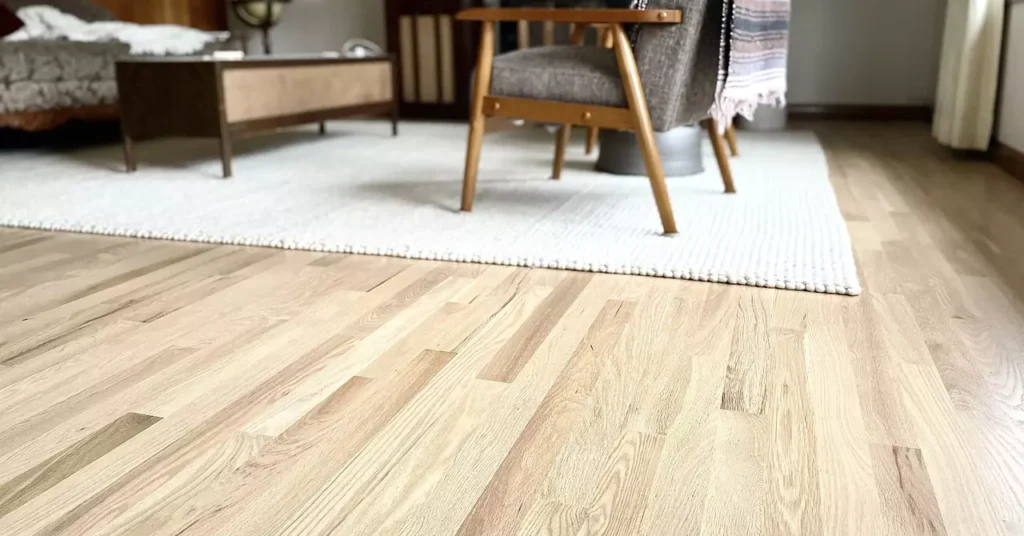
Two floor problems, two fixes. If your floors are nice, protect them. Felt pads under every furniture leg, and a rug pad under any rug so the backing doesn’t discolor the finish. Scratched hardwood is a real deduction, and it’s the one people forget until they drag a sofa across the room on move-in day.
If your floors are the problem, scuffed vinyl or dated tile or a carpet color you’d never have picked, a large rug is the highest-leverage fix in this entire guide. It covers the most surface for the least money and installs in the time it takes to unroll it. Peel-and-stick vinyl plank over a bad kitchen or bathroom floor is the more ambitious version, reversible on the right subfloor, and worth the effort if you’re staying more than a year.
Lighting Without an Electrician
You can’t rewire a rental, and you don’t need to. Overhead lighting in most apartments is one harsh fixture doing all the work, and the fix is to ignore it and build light at lower levels instead. A floor lamp in the corner, a table lamp on a nightstand, a small lamp on a shelf. Three plug-in sources at different heights turn a flatly-lit box into a room with depth. Battery-powered or stick-on LED sconces give you the mounted-light look with a strip of adhesive and no junction box. And a couple of smart bulbs in the lamps you already own let you drop the color temperature warm at night without touching a single wire.
The Entryway You Don’t Technically Have
Most small apartments open straight into the living space. No foyer, no coat closet, nowhere to set down keys. You can build a functional entry against a bare wall using only adhesive hooks, a leaning mirror, and a narrow freestanding shelf. No drilling, fully removable, and gone without a trace when you hand back the keys.